
Inside India’s Public Sector Banks: AIWBOA Leader Alleges Systemic Targeting, Workforce Stress and a Policy-Driven Crisis
All India WeBankers Officers’ Association (AIWBOA)’s Prabin Kumar Biswas alleges systemic targeting of Public Sector Banks staff, severe manpower shortages, and policy-driven weakening of banks, raising serious concerns about governance and employee welfare.
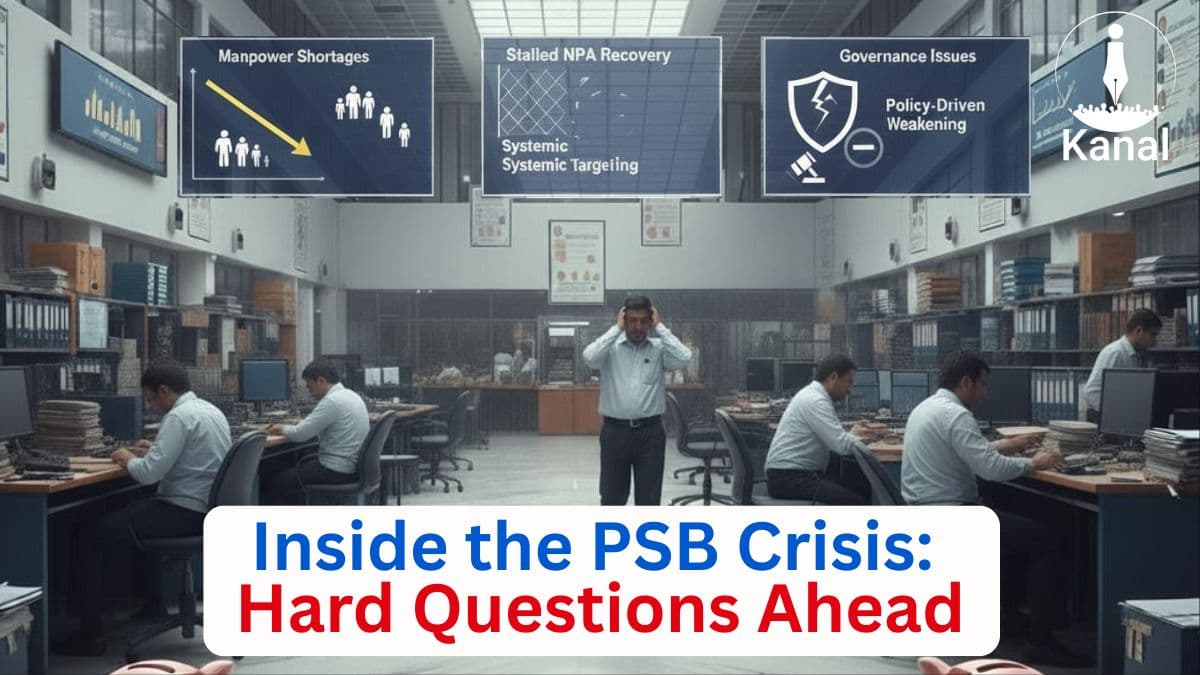
Author: Neha Bodke
Published: 1 hour ago
A public statement by Prabin Kumar Biswas, National General Secretary of the All India WeBankers Officers’ Association (AIWBOA), has triggered intense discussion across the banking sector. In his detailed analysis, Biswas alleges that India’s Public Sector Banks (PSBs) are not merely facing operational challenges but are undergoing what he describes as a “structured internal breakdown,” driven by policy decisions and administrative actions.
The note raises serious concerns about disciplinary practices, workforce stress, loan recovery inefficiencies, and the long-term direction of public sector banking. Kanal Media examined the key points flagged in the statement.
Targeting of Field Functionaries and Disciplinary Actions
According to Biswas, frontline officers, the staff responsible for sourcing business and handling daily operations, are increasingly subject to strict disciplinary measures.
He alleges that memos, charge sheets and punitive actions are being initiated “for minor procedural lapses,” in what he calls a sharp rise in punitive action for issues such as missing signatures, documentation gaps, or genuine operational bonafide errors.
The note characterises the system as one where punishments are disproportionate, raising questions on how natural justice principles are being applied in internal inquiries.
Biswas further states that in some instances, previously paid allowances and TA bills are being recovered with interest, which he terms an “excessive and coercive administrative step.”
The allegations point to a growing perception among bank officers that compliance measures are hardening in a way that impacts morale at the branch level.
Contradiction Highlighted: Staff Recoveries vs. NPA Recoveries
A major theme in the AIWBOA leader’s note is the comparison between action against staff and the banking system’s performance on large corporate loan recoveries.
Biswas notes that while minor staff-related financial recoveries are pursued rigorously, large-scale Non-Performing Assets (NPAs) from wilful defaulters remain unresolved.
He argues that this imbalance has created frustration among employees who feel that stricter internal governance standards are not matched by aggressive recovery from major defaulters.
Previous Kanal reports have also documented cases where bank staff faced investigations for operational lapses, even as loan accounts involving large borrowers remained stalled at various stages of legal recovery.
Workforce Shortages and Rising Stress: “A Pressure-Cooker Environment”
The AIWBOA statement sharply focuses on the issue of recruitment stagnation. Biswas argues that the lack of new hiring has “significantly altered the working environment” inside PSBs.
Key points raised include:
-High workloads due to limited staff availability.
-Employees reporting physical and mental stress, especially in branches with heavy footfall.
-Concerns that branch operations, customer handling, and business growth are all affected when sanctioned strength is not met.
Multiple Kanal investigations in recent months have highlighted similar cases, including instances where employees flagged burnout, extended working hours, and an increase in pressure-related health complaints.
Leadership Appointments and Policy Direction
The note alleges that the Chairmen and Managing Directors of PSBs, being government-appointed positions, are “carrying out directives that ultimately pave the way for consolidation or privatisation.”
Biswas claims:
-Poor performance arising from stress, manpower shortages, and morale issues is eventually cited as evidence of a “weak bank.”
-These assessments later become grounds for structural steps such as mergers or shifts in ownership models.
The statement suggests that the decline is not accidental but the result of “policy-driven decisions,” though no direct evidence was provided beyond internal observations and trend analysis.
Public Funds, Welfare Expenditure, and Systemic Strain
Another issue highlighted in the note is the use of public sector banks to support government schemes.
Biswas argues that the burden of implementing welfare initiatives, maintaining extensive rural reach, and meeting service obligations without proportional staffing or compensation has added stress to the system.
The note links these pressures to what he describes as the “erosion of PSB strength,” urging greater scrutiny of how public resources and taxpayer contributions are being managed.
A Workforce That Cannot Walk Away
A striking element of the AIWBOA leader’s analysis is the observation that bank employees, despite workplace challenges, remain committed to their roles due to the sector’s professional culture and legal responsibilities.
Biswas points out that unlike certain industries where labour disruption is common, bank employees cannot abandon their duties, as even short disruptions affect public money, government payments, pension disbursements, and critical financial services.
This, he says, creates a paradox: the sector’s discipline becomes a barrier to large-scale collective protest, even where employees feel distressed.
Broader Sector Context
The concerns raised in the statement add to a growing list of issues flagged by bank unions over the years:
-Staff shortages
-Branch overload
-Outsourcing of services
-Rising expectations from digital adoption
-Long-pending NPA resolution
-Increasing regulatory obligations at the branch level
Recent Kanal reports on employee stress-related incidents, disciplinary interventions, and loan recovery delays provide additional context for the claims made in Biswas’s statement.
Biswas’s note has amplified ongoing conversations within the banking community about organisational culture, governance structures, and long-term PSB health.
The allegations, though yet to be examined officially, highlight tensions between frontline operations and policy direction at the top.
Kanal Media will continue tracking responses from stakeholders, including bank managements, the Department of Financial Services, union bodies, and employee associations, as discussions around PSB reform and workforce welfare gain momentum.
Advertisement
No comments yet.